
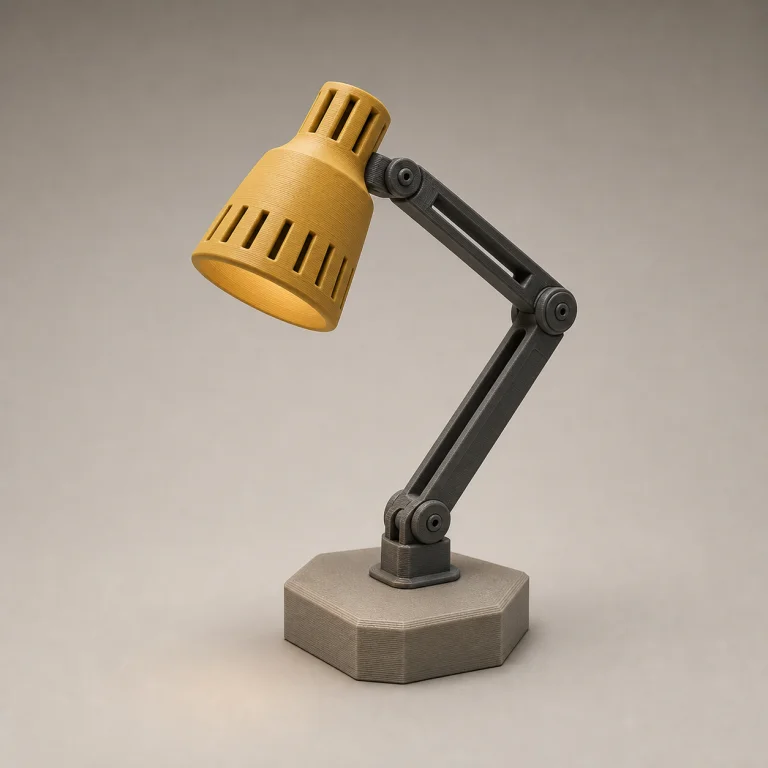
Image-to-3D has moved beyond “a mesh that vaguely matches.” The current question is whether a result preserves the silhouette, reconstructs useful hidden geometry, carries believable physically based materials, and remains practical to edit or print. Microsoft’s TRELLIS.2 and Tencent ARC’s Pixal3D answer that question from closely related starting points.
What TRELLIS.2 changes
TRELLIS.2 is Microsoft’s 4-billion-parameter image-to-3D release built around O-Voxel structured latents. Its representation supports open surfaces, non-manifold geometry, internal structures, and material channels including base color, roughness, metallic, and opacity. That makes it a strong general-purpose source for GLB assets rather than a geometry-only novelty.
The official project requires an NVIDIA GPU with at least 24 GB of VRAM. Its published H100 timings are roughly 3 seconds at 512³, 17 seconds at 1024³, and 60 seconds at 1536³. Those are not RTX 5090 guarantees, but they show why resolution needs to be a visible product choice rather than a hidden switch. NVIDIA’s own 3D object generation blueprint, which uses TRELLIS, describes up to about 45 seconds per object on an RTX 5090.
Where Pixal3D differs
Pixal3D, accepted to SIGGRAPH 2026, explicitly back-projects image features into 3D. The goal is a more direct correspondence between input pixels, geometry, and PBR texture. Its current main implementation is itself built on the TRELLIS.2 backbone, so this is less “unrelated rivals” and more “foundation model versus a reconstruction-focused specialization.”
Pixal3D offers an official low-VRAM mode that loads stages on demand, defaults to 1024 in that mode, and can use PyTorch SDPA when Flash Attention is unavailable. Its extra view-aligned conditioning is appealing for products, characters, and objects whose printed or rendered identity depends on small image details.
| Decision | TRELLIS.2-4B | Pixal3D |
|---|---|---|
| Best starting point | General local PBR generation and varied drafts | Reference-faithful, pixel-aligned reconstruction |
| Representation | Native structured O-Voxels | TRELLIS.2 backbone plus pixel-aligned projection conditioning |
| Local memory strategy | 24 GB minimum; staged low-VRAM pipeline | Official on-demand low-VRAM mode |
| Default SimplexGen route | Local RTX 5090, background-only | Hosted queue for predictable availability |
| Print workflow | Inspect scale and walls, repair, simplify or remesh, orient, then support-preview and slice | |
How we fit it on one RTX 5090
SimplexGen runs TRELLIS.2 behind OmniServe Native instead of keeping 16+ GB of checkpoints resident forever. The gateway forces every 3D request into its background tier. The worker checks for at least 24 GB free before it starts, launches a single cold inference process in low-VRAM mode, exports the GLB, optionally moves it to R2, records searchable gallery metadata, and exits. Interactive image, speech, and language workloads keep priority.
This has a deliberate trade-off: a local generation can wait while the GPU is busy. The response is a real capacity signal, not an out-of-memory crash or a surprise eviction. It also means a finished job returns the 5090 to the shared system rather than leaving an idle model resident.
Premium API pricing
The local route is priced above our basic hosted Pixal conversion because it reserves a whole background GPU window, exports PBR materials, stores the asset, and indexes it. Higher resolutions scale the price sharply because their latency and peak memory are not linear.
Pixal3D remains the economical option at 1 credit for a 1024 texture and 2 credits for 2048 or 4096. That price separation is intentional: use inexpensive conversion to explore, then spend premium local compute on the references worth carrying forward.
ShapeNet without filling the workstation
ShapeNetCore covers 55 common categories and about 51,300 models. We index it as metadata over a licensed mount rather than duplicating the whole corpus. A bounded importer caps objects per category and total entries, emits a compact JSONL gallery index, and can point finished public assets at R2. This gives search breadth—chair, lamp, camera, vessel, guitar, and more—without casually consuming the machine’s working disk.
ShapeNet is a reference and research corpus, not a blanket permission to republish every mesh. SimplexGen keeps source labels and separates metadata indexing from public asset publication so access and licensing decisions stay explicit.
A practical production recipe
- Use a centered single object with an uncluttered or transparent background.
- Run TRELLIS.2 at 512 and Pixal3D at its economical tier; compare silhouette, back-side plausibility, thin features, and materials.
- Promote only the stronger candidate to 1024 or 1536.
- For printing, set real dimensions, detect non-manifold edges and thin walls, repair, then use auto-orient for stability or reduced support.
- Keep the original high-detail GLB and derive a separate decimated, remeshed print asset.
Turn a reference into a PBR object
Use the local TRELLIS.2 tool for premium background generation, or open the gallery to compare printable forms and category references.
Open TRELLIS.2