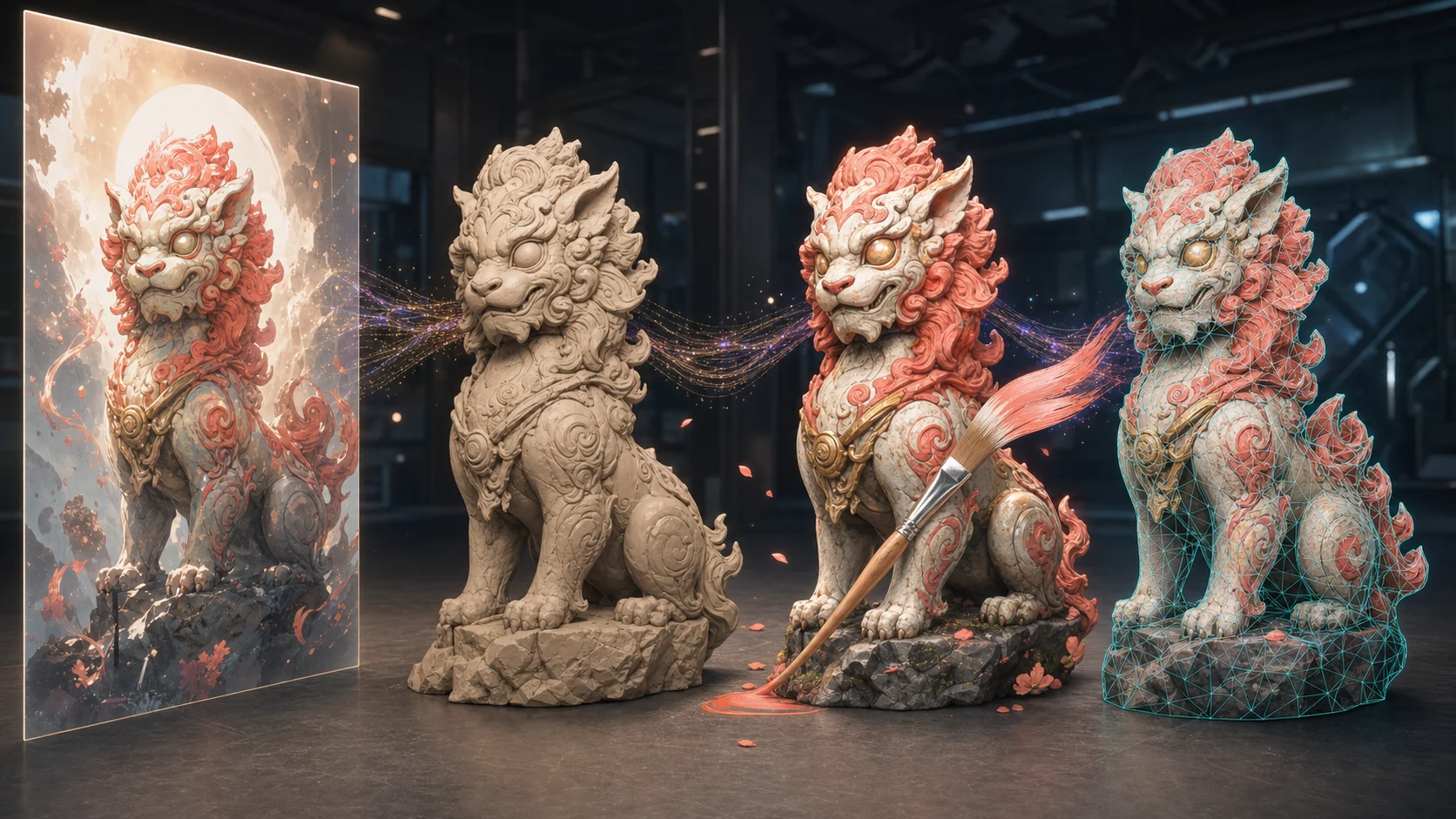
An AI-generated mesh is an observation, not a finished asset. It contains a hypothesis about unseen geometry, surface material, scale, and topology. The next tools must decide which parts are evidence and which are disposable scaffolding.
Stage ZeroWrite a Preservation Contract
Before editing, record what must survive: silhouette, painted motifs, material channels, exact scale, sharp boundaries, named parts, or rig landmarks. Different operations preserve different invariants. A method can be mathematically “shape preserving” while destroying UV correspondence or semantic edge flow.
Stage OneReconstruction Produces Multiple Kinds of Uncertainty
A single image strongly constrains the visible silhouette and front-facing texture but weakly constrains the back, interior, and thickness. Treat generated hidden geometry as lower-confidence evidence. Keep the original camera and reference image available for reprojection checks.
Immediately inspect disconnected shells, self-intersections, nonmanifold edges, inverted normals, thin walls, and implausible scale. Repair catastrophic defects before painting, but avoid an aggressive remesh until you understand which surface parameterization came with the generated asset.
Stage TwoPainting Creates a Signal Bound to a Domain
Texture paint is not “on the mesh” in a vague sense. Raster paint lives in an image and reaches the surface through UV coordinates. Vertex paint lives directly on samples. Procedural masks may live in object or world space. Every representation has a different response to topology change.
- Same vertices and UVs: keep the texture object and UV array exactly. No rebake is needed.
- Changed topology, same UV atlas: interpolate UVs carefully and validate seams.
- New UV atlas: bake old material appearance onto the new surface with ray correspondence and dilation.
- Vertex colours or masks: transfer using barycentric projection, not nearest-vertex copying.
Stage ThreeWhen Voronoi/QEM Improvement Can Preserve Paint Exactly
A same-topology Voronoi relaxation moves sites tangentially, constrains candidates back to the source, and uses quadric error to resist shape drift. Connectivity remains fixed. Because vertex count, indices, and UV attributes remain identical, the painted texture stays attached bit for bit.
This is better than rebaking. A bake introduces sampling blur, padding decisions, and possible seam contamination. When the domain has not changed, the faithful operation is to preserve it.
normals: recomputed
indices: identical
UVs / colours / masks: identical
texture canvas and material binding: identical
“Retopology” is sometimes used broadly for any topology improvement. Be precise: a relaxation improves triangle distribution but does not create animation-friendly edge loops or reduce polygon count. Exact paint preservation is possible precisely because connectivity did not change.
Stage FourWhen Connectivity Must Change
Decimation, voxel remeshing, isotropic split-collapse, quad conversion, and full retopology create a new domain. Exact UV-array preservation is then impossible. The correct goal becomes appearance preservation.
Build a correspondence from every target texel or vertex back to the source surface. Ray casting works well when surfaces are close and consistently oriented. Closest-point projection is robust for local transfer but can jump across thin gaps. Cage or signed-distance methods help when offsets are larger.
Transfer base colour, roughness, metallic, emission, opacity, and displacement separately. Normal maps require tangent-basis conversion. Dilate texture islands after baking and inspect across every seam. Preserve the source until the new representation passes visual and numerical checks.
Stage FiveBuild Chains as Transactions
A reliable application treats each stage as a history step with declared inputs and outputs. Paint, relax, simplify, unwrap, and bake should not mutate one anonymous mesh beyond recovery. Every geometry replacement should be undoable independently of texture history.
For a chain such as generate → repair → paint → Voronoi relax → simplify → rebake, store checkpoints before the two operations that change correspondence: simplification and unwrapping. If the final bake fails, the painted relaxed mesh remains available as a clean source.
Stage SixValidate More Than One Camera Angle
A front view can hide inverted back faces, seam bleeding, paint projection through thin surfaces, and silhouette drift. Review at least front, three-quarter, grazing, and rear angles. Use a wireframe overlay to distinguish shading improvement from actual topology quality.
Automated checks should measure index count, attribute count, maximum UV delta, texture identity, maximum source-surface deviation, triangle quality, boundary locks, and monotonic improvement of the chosen energy. Visual checks catch everything those metrics fail to describe.
AI’s Best RoleGenerate Hypotheses; Let Geometry Prove Them
AI is excellent at proposing form, material language, semantic parts, and variations. Differential geometry is excellent at enforcing local consistency, measuring distortion, diffusing signals, and preserving constraints. The strongest pipeline uses both.
A learned model may suggest where a crease belongs. A feature-aware operator decides how influence crosses it. A generative texture may supply a motif. UV-preserving relaxation keeps it exact; a topology-changing bake transfers it explicitly. Provenance ties the final model back to the image, prompt, model version, and transformation chain.
Release ChecklistWhat to Store With the Marketplace Asset
- Original reference image, prompt, and generation model metadata.
- Immutable high-detail source plus an editable production mesh.
- PBR textures in stable public storage, not expiring presigned URLs.
- Real dimensions, units, manifold status, wall-thickness notes, and print orientation.
- Thumbnail renders from multiple angles and a crawlable canonical landing page.
- License, creator/source attribution, tags, and a revision identifier.
The result is more than a downloadable GLB. It is a traceable, editable asset whose visual intent survives the operations required to make it useful.