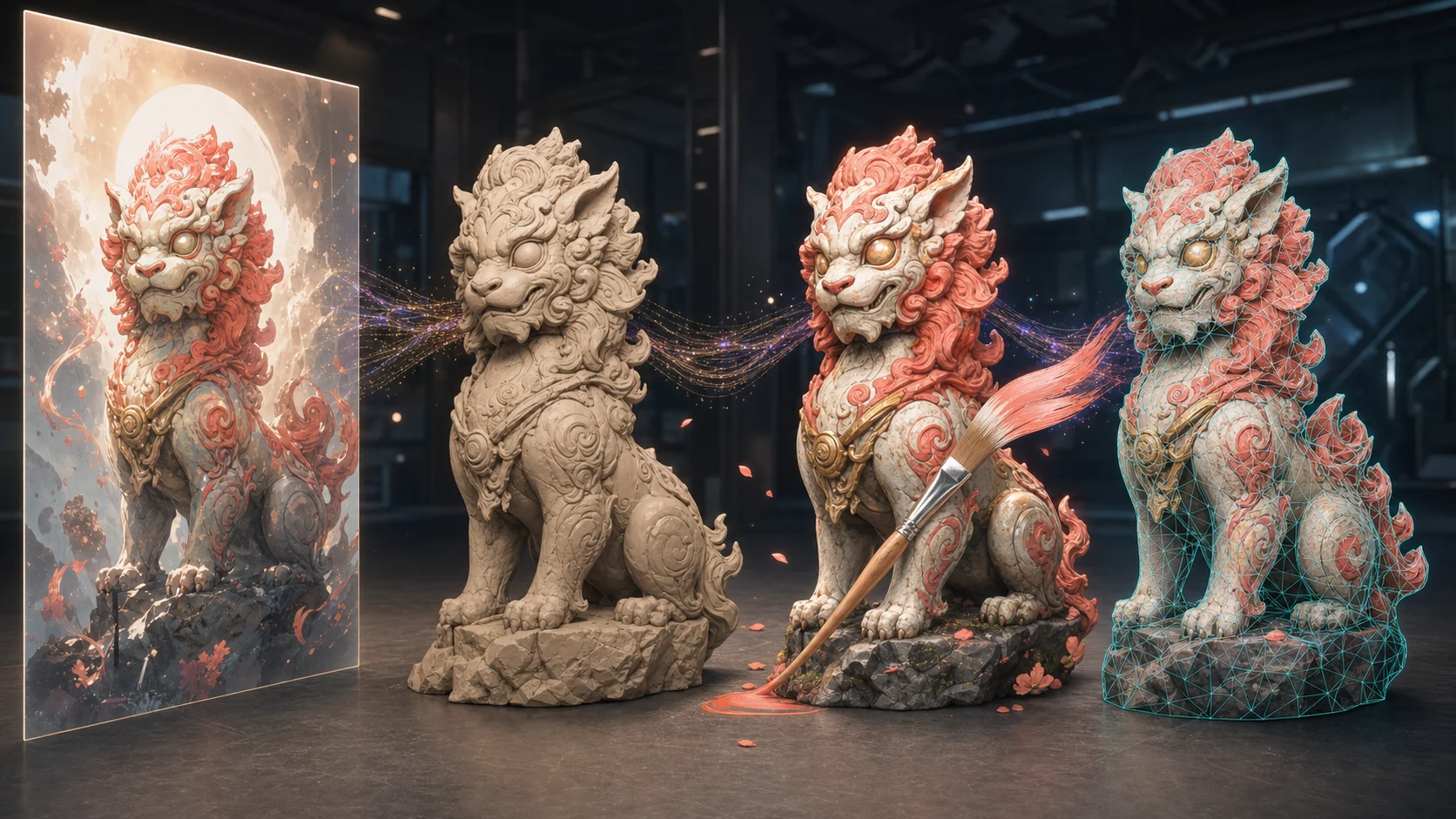
Start at DeliveryName the Asset You Actually Need
A marketplace turntable can tolerate dense triangulation that a rig cannot. A product visualization needs convincing roughness and metallic response; a resin miniature needs a closed shell and printable features. Before choosing a model, specify silhouette tolerance, topology, materials, UVs, scale, minimum thickness, open-surface policy, and the human editing budget.
Sparse Structured FieldsTRELLIS.2 for Flexible Surface and Material Generation
TRELLIS.2 uses a structured sparse-voxel representation called O-Voxel. Its official implementation describes field-free sparse voxels, arbitrary topology, PBR materials, and generation at several resolution levels. That makes it a useful candidate when image-conditioned shape, open or complex surfaces, and material appearance matter more than hand-authored edge flow.
The conversion cost remains real: extraction produces a renderable surface, not necessarily the polygon layout, UV organization, wall thickness, or component semantics required by animation or fabrication.
Geometry Plus PBRHunyuan3D 2.1 as an Open Production Baseline
Hunyuan3D 2.1 publishes an open framework that separates shape generation from PBR texture synthesis. That separation is operationally useful: geometry can be validated before spending time on appearance, and texturing can be rerun without silently changing the shape. It is a sensible baseline when a reference image and physically based texture channels are central to the brief.
Autoregressive PolygonsMesh Tokens for Compact, Editable Structure
MeshGPT models polygonal meshes as token sequences, while MeshAnything V2 introduces adjacent mesh tokenization to improve sequence efficiency and face continuity. These methods are valuable when the desired output is recognizably mesh-like—compact faces and more deliberate connectivity—rather than a dense field extraction.
Autoregression also introduces sequence limits and ordering sensitivity. It is often strongest as a topology stage conditioned on a point cloud or previously generated shape, not as the only system responsible for geometry, material, manufacturing, and semantics.
Continuous GenerationDiffusion and DMTets for Shape Distributions
MeshDiffusion demonstrates diffusion over deformable marching-tetrahedra parameters. The fixed scaffold makes learning convenient while surface extraction permits topology changes. This is compelling research machinery for generation, interpolation, and completion; the extracted mesh still requires the same explicit production checks as any other isosurface.
A Practical RouterMake the Decision Inspectable
def choose_3d_pipeline(job):
    if job.needs_artist_topology:
        return ["shape_reference", "point_conditioning",
                "adjacent_mesh_tokens", "surface_projection", "qa"]
    if job.needs_pbr_from_reference:
        return ["hunyuan_shape", "geometry_qa",
                "hunyuan_pbr", "material_qa"]
    if job.has_complex_or_open_surfaces:
        return ["trellis_ovoxel", "extract_mesh",
                "retopology_if_needed", "qa"]
    if job.is_printed:
        return ["best_shape_candidate", "make_solid",
                "thickness_and_scale", "slice_preview", "print_qa"]
    return ["generate_multiple_representations", "score", "human_review"]
The route should return more than a model name. Record model and revision, seed, conditioning asset hash, coordinate convention, intermediate representation, extraction settings, repair operations, and validation scores. Reproducibility lives in this manifest.
Candidate StrategyGenerate Breadth Before Expensive Cleanup
- Generate low-cost candidates and reject obvious silhouette, symmetry, or semantic failures.
- Render fixed diagnostic cameras and score multi-view consistency.
- Run geometric checks: components, boundaries, self-intersections, normals, and scale.
- Only then run high-resolution extraction, PBR synthesis, UV work, retopology, and print repair.
- Keep rejected candidates and reasons; they become valuable evaluation data.
Hybrid ProductionOne Model Rarely Owns the Whole Asset
A robust chain may use a field model for broad shape, surface sampling for representation transfer, mesh tokens for compact topology, a dedicated PBR system for appearance, and deterministic geometry tools for manufacturing. The crucial boundary is the comparator: every conversion must be checked against the previous master with surface distance, silhouette renders, attribute coverage, and human review.
This prevents a familiar failure: the final file is technically clean, yet no longer looks like the approved concept. Production quality is both mathematical validity and continuity of intent.