Geometry, AI & 3D Printing
Learn the complete chain: mesh structure, surface mathematics, printable solids, augmentation, tokenization, diffusion, current AI representations, texture preservation, and validated release.
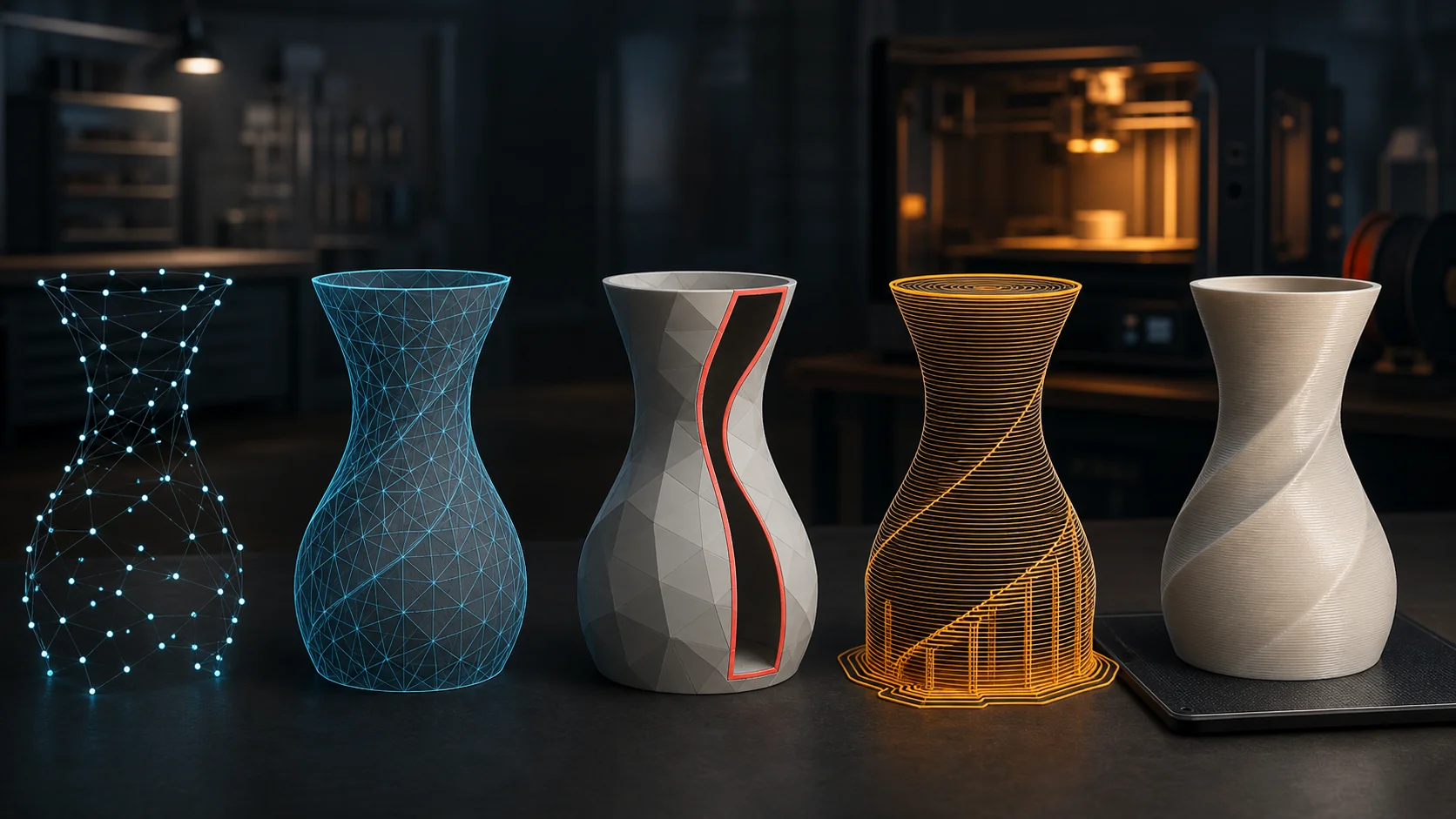
From Mesh to Manufactured Object
Representations, contracts, checkpoints, and the complete geometry-to-print pipeline.
12 min 02Differential Operators and Surface Signals
Gradient, divergence, cotangent Laplacians, mass matrices, Poisson, and harmonic fields.
24 min 03Print-Ready Meshes
Watertightness, manifoldness, wall thickness, overhangs, supports, scale, and 3MF.
15 min 04What Frequencies Mean on a Mesh
Natural shape harmonics, filtering, compression, descriptors, and segmentation.
10 min 05Mesh Augmentation with PyTorch3D
Safe transforms, surface sampling, noise, remeshing, labels, and reproducible batches.
16 min 06Mesh Tokenization for Transformers
Quantization, face order, adjacency, MeshGPT, MeshAnything V2, and sequence budgets.
14 min 07Diffusion on Meshes and DMTets
Why fixed topology helps, how deformable tetrahedra expose surfaces, and what diffusion learns.
13 min 08Choosing AI 3D Models by Representation
TRELLIS.2, Hunyuan3D 2.1, mesh autoregression, and hybrid production routing.
14 min 09Image to 3D to Paint to Retopology
Preserve UVs, material intent, correspondence, provenance, and visual identity.
11 min