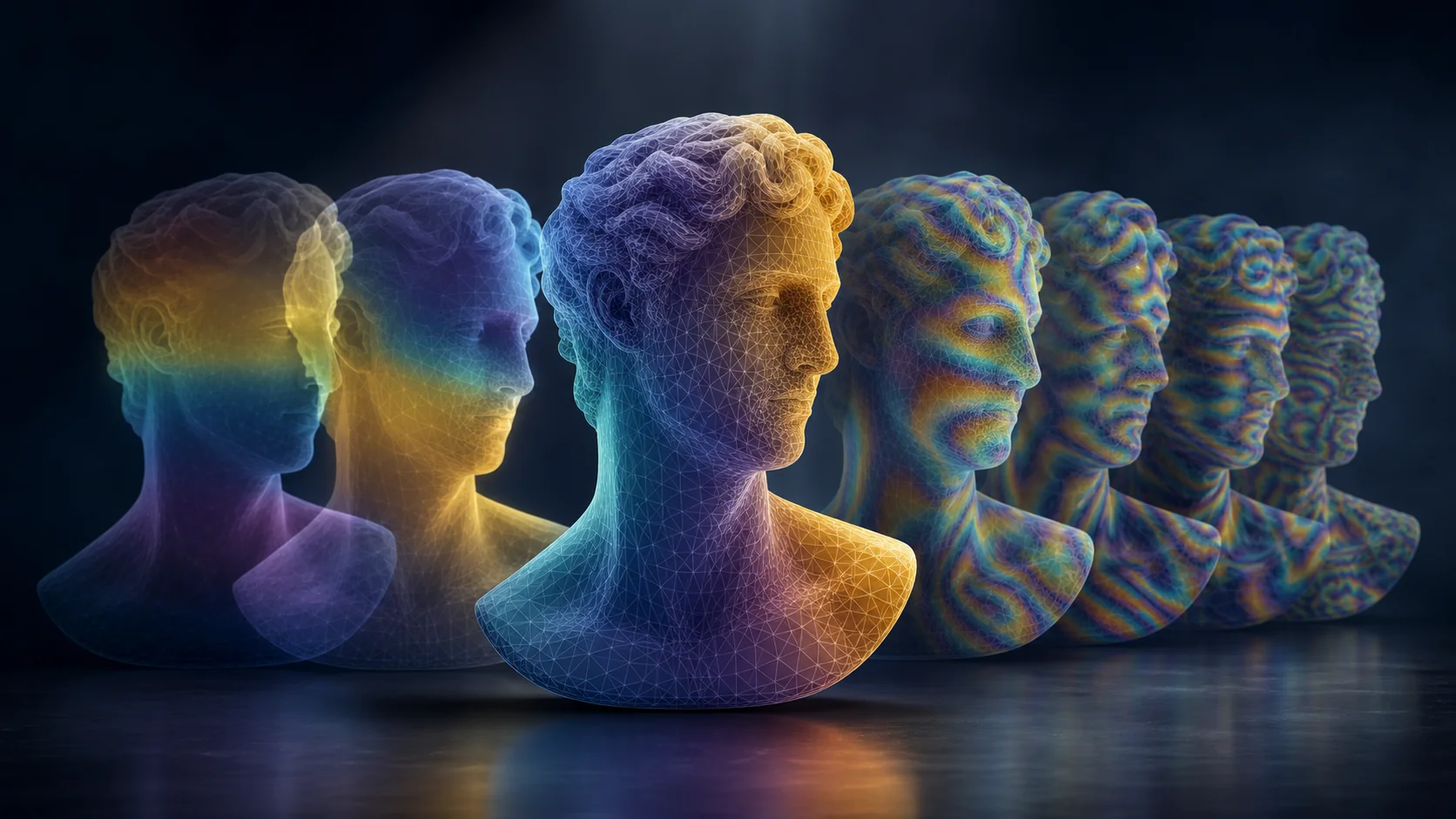
On a regular image, a Fourier basis gives us waves of increasing horizontal and vertical frequency. A mesh has no uniform x–y lattice, so ordinary sine waves no longer fit. Instead, the mesh’s Laplacian supplies a basis adapted to the shape.
The Key ConstructionAsk Which Signals Reproduce Their Own Laplacian
An eigenfunction is a surface signal whose Laplacian produces the same signal multiplied by a number. That number is the eigenvalue. The smallest eigenvalue corresponds to the constant signal: no variation at all. The next few functions divide the object into broad, slowly varying regions. Later functions oscillate rapidly.
L = geometric stiffness / cotangent Laplacian
M = surface-area mass matrix
φ = a natural mode of the surface
λ = its frequency-like eigenvalue
The mass matrix matters. Without it, a dense patch of tiny triangles counts as more important merely because it has more vertices. The generalized problem asks about variation per unit surface area, not variation per sample.
Geometry-Aware FrequenciesThe Basis Belongs to the Shape
A long thin handle supports different modes from a compact sphere. A character’s limbs create low-frequency partitions because long geodesic distances separate them. Holes and branches shape the spectrum. The basis is intrinsic enough to remain relatively stable under bending that does not stretch the surface.
This is why spectral descriptors can recognize related poses. A sitting character and a standing version may have very different coordinates but similar intrinsic geometry. Their low spectrum captures structure more than pose.
Spectral FilteringSmoothing as a Frequency Decision
Express a coordinate or paint signal as a weighted sum of eigenfunctions. Reducing coefficients attached to large eigenvalues removes fine oscillations. Keeping only low modes gives a smooth approximation. Amplifying a selected band can sharpen a particular scale of detail.
Heat diffusion has an especially clean spectral interpretation: every mode decays exponentially, and high-frequency modes decay fastest. This is why tiny noise vanishes before broad structure under diffusion.
Taubin smoothing can also be understood as designing a response curve that suppresses undesirable high modes without collapsing the lowest modes responsible for global scale.
CompressionA Shape as a Short Vector of Coefficients
If a smooth object is well approximated by a few hundred basis functions, we can store those coefficients instead of every coordinate independently. The approximation degrades gracefully: broad form arrives first, then medium shape, then fine detail.
This is compelling for progressive transmission, animation caches, neural descriptors, and retrieval. But the basis itself depends on the mesh, so comparing coefficients across unrelated topology is not automatic. Correspondence must be established, or a basis-invariant descriptor must be used.
Shape AnalysisHeat, Waves, and Signatures
The heat kernel signature records how heat placed at a point would dissipate over several time scales. Short times describe local geometry; long times describe the global shape. The wave kernel signature uses quantum-like oscillatory behaviour to form another multi-scale fingerprint.
These signatures support matching, segmentation, symmetry detection, and retrieval. They are richer than raw curvature because they combine information across neighborhoods and scales.
SegmentationLow Modes Reveal Large Parts
The first nonconstant eigenfunctions often divide a shape along meaningful structural bottlenecks. A quadruped may separate along its body and limbs; a vessel may separate body, neck, and handles. Clustering several low-dimensional spectral coordinates creates a geometry-aware embedding in which related surface regions sit close together.
The result is not semantic understanding by itself. Symmetric parts may swap, and a topological shortcut can distort the basis. But spectral coordinates are a strong structural substrate for learned or rule-based segmentation.
Production LimitsThe Spectrum Is Only as Good as Its Discretization
Nonmanifold edges, duplicate shells, degenerate triangles, wildly nonuniform sampling, and accidental bridges all contaminate spectral behaviour. Repeated eigenvalues also create ambiguous bases: any rotation inside the repeated eigenspace is mathematically valid.
Large eigensystems are expensive, so practical tools calculate only the first portion of the spectrum using sparse iterative solvers. Dynamic topology invalidates the basis. Changing a mesh substantially means recomputing it.
Still, spectral thinking is invaluable even without an eigensolver. It encourages the right question: which spatial scales contain noise, which contain identity, and which should a tool preserve?
Artist’s TranslationFrequency Bands Are Detail Scales
- Lowest modes: global proportion, broad pose-independent structure, overall scale.
- Low-to-mid modes: limbs, large folds, silhouette character, primary segmentation.
- Mid-to-high modes: wrinkles, engravings, scan texture, brush marks.
- Highest modes: discretization noise, tiny bumps, aliasing—and occasionally precious microdetail.
A good geometry filter does not merely “smooth.” It expresses an opinion about this hierarchy.